International financial glossary for PYMEs in Morocco

If your company in Morocco imports or exports, makes payments or collections in foreign currency, or negotiates with clients or suppliers abroad, this glossary is for you. Here we explain the key terms you need to know to manage your international operations with more control, speed, traceability and confidence.
Each definition is accompanied by examples and practical notes to help you make informed decisions that are aligned with local regulations.
Foreign currency account
Definition: It is a bank account opened in a currency other than the Moroccan dirham (MAD).
Example: An exporting company in Casablanca opens a USD account to receive payments from a client in the US. US, thus avoiding immediate conversion to MAD.
Practical note: These accounts can only be opened in authorised banks and under the conditions set by the Exchange Office. Make sure you know the procedures and requirements.
Exchange Office
Definition: Moroccan state authority that regulates foreign currency transactions, capital movements, international transfers, the opening of foreign currency accounts, etc.
Importance for your SME: The Exchange Office defines the limits for transfers, the requirements for receiving or sending money, and the rules for repatriating funds, so it is vital to avoid penalties or blocks.
SWIFT / BIC
Definition: alphanumeric code that uniquely identifies a bank in international transactions (for example: BCMAMAMCXXX for Attijariwafa Bank in Casablanca).
Use: it is mandatory to send or receive money from abroad.
Tip: always verify that you have the correct receiving bank code to avoid returns or delays.
RIB (Relevé d’Identité Bancaire)
Definition: code that identifies a bank account in Morocco.
International equivalent: In Europe, the IBAN is used; In Morocco, RIB + SWIFT are used for international transfers.
Note: Make sure your suppliers or customers know both your RIB and the correct SWIFT of the bank.
International transfer times
Typical estimate: 1 to 5 business days, depending on the country of origin/destination, the currency and documentary compliance.
Caution: Banks may withhold funds if any document is missing or if the transaction requires authorisation from the Exchange Office.
Exchange rate
Definition: value of one currency expressed in another (for example, EUR/MAD).
Impact on your business: It directly affects your revenue (if you export) and your costs (if you import).
Recommendation: Always check the official Bank Al‑Maghrib rate and compare it with the rate offered by your bank or platform.
Pro tip thanX: With thanX you see the exchange rate in real time to make informed decisions.
Exchange rate spread
Definition: difference between the official or market exchange rate and the one applied by the financial institution.
Example: If 1 EUR = 10.80 MAD officially, but your bank applies 10.50 MAD, the spread is 0.30 MAD.
Tip: A good spread reduces your costs, so compare several offers before closing.
Value thanX: Transparency in the spread so you can see what you’re paying.
Direct debit (Foreign trade operations)
Definition: mandatory process of registering the import or export operation with an authorised Moroccan bank.
Common documents that are required:
- Proforma or commercial invoice
- Import commitment (Engagement d’Importation)
- Customs declaration (DUM)
Advice for SMEs: Keep a digital archive of these documents: It simplifies management, avoids errors, and speeds up transfers.
Fintech and digital transfers
Definition: Technological platforms (for example, Wise, Revolut, Payoneer…) that allow you to send and receive international funds more quickly and cost-effectively.
Advantages:
- More competitive exchange rate
- Lower fees
- 100% digital operations
Limitations to watch out for:
- Some may not allow direct conversion to MAD or transactions with the Exchange Office.
- The beneficiary must be the registered holder.
Taxation of international transfers
Alert for your SME: Some transfers may be subject to taxes or withholdings depending on the country of origin, the amount, or the type of economic activity.
Practical example: A Moroccan company receives a large payment from France. France may apply a 15% withholding tax if there is no double taxation agreement.
Recommendation: Consult with your bank or tax advisor before receiving large sums or establishing relationships with clients - extra important for Moroccan exporters.
Exportable/importable currency limits
Definition: the rules that the Exchange Office imposes on how much can be transferred or received in foreign currency, when authorisation is required, etc.
Important notes:
- Some operations require prior authorisation from the regulatory body.
- Anti-fraud controls are in place.
Why it matters to you: If you regularly import or export, knowing and complying with these limits prevents penalties or blocks that can paralyse your business.
UETR (Unique End‑to‑End Transaction Reference)
Definition: A unique code that identifies an international transaction from beginning to end, allowing its status to be tracked exactly at each step (origin, correspondents, destination).
Key benefit: Full traceability, because you know where your money is, when it was processed and whether there is any hold - peace of mind for your SME.
Practical tip: Always request this number when making your transfer to have visibility and avoid uncertainty.
Letter of Credit (Letter of Credit – LC)
Definition: A payment instrument used in international trade in which a bank undertakes to pay the exporter provided that the agreed documents are presented correctly.
Example for Moroccan SMEs: If you export products to a customer who requires security, you can use an LC to guarantee payment.
Advantage: It reduces the risk of the customer not paying.
Note: It involves additional bank costs and procedures and is not as fast as a simple transfer.
Correspondent Account (Cuenta corresponsal)
Definition: account held by a bank in another country (or foreign bank) to facilitate payments in that currency or country.
Importance for your business: Many Moroccan banks have correspondent accounts abroad to process your transfers. Knowing this helps you understand why additional charges or delays may apply.
Netting / Compensation (Position Netting)
Definition: technique by which various payment obligations between parties are mutually offset to reduce the number and volume of transfers.
Application for SMEs: If you have multiple relationships with a foreign supplier or conduct multiple transactions, you could agree to offset balances to save on transfer costs and simplify cash flow.
Proforma invoice
Definition: Advance document that describes the goods to be exported or imported, with price, terms, etc., but which is not yet the final commercial invoice.
Practical use: It is very common in Morocco for bank domiciliation procedures and transactions with the Exchange Office. It defines expectations between supplier and buyer before shipment.
Remittances (Remittances)
Definition: money transfers made between countries, whether by individuals or companies. In the context of export/import, it refers to payments received from abroad.
Relevance: Moroccan SMEs that export need to understand how these remittances are processed, what documentation is required, and how it affects traceability and accounting records.
Final tips for your business
- Digitise your international payments and collections: Use state-of-the-art platforms like thanX, which offer easy integration, visibility, and human support.
- Always compare the exchange rate and fees before each transaction. A small recurring saving adds up.
- Keep a clear and organised record of your transactions, documents (invoices, direct debits, customs declarations), and references (UETR, RIB, SWIFT).
- Rely on human support: Even though everything is digitised, it is always valuable to have a trusted advisor or bank that knows Moroccan regulations.
- Stay regularly informed about changes in the regulations from the Exchange Office: The requirements may evolve.
Are you ready to boost your international operations?
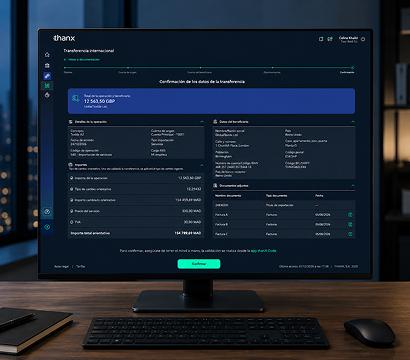
With thanX you can send, receive and convert currencies digitally, quickly and securely. You’ll see the exchange rate in real time, have complete visibility of the status of your transfers, and have full control and specialised support tailored to Morocco.
How to send money abroad from Morocco: Practical guide for companies
Learn about the available options, local regulations, and best practices for sending money abroad safely and efficiently.
Dirham to euro exchange rate: Keys to protecting your business
If you operate in Morocco and need to convert dirhams to euros, we explain how the exchange rate works, which factors affect it, and how to avoid unnecessary losses.

Keys to making international transfers from Morocco
Discover how to make international transfers from Morocco securely and efficiently. Learn about the requirements, costs, time frames, and how to simplify the process.
How to make payments to international suppliers from Morocco
Discover how to make payments to international suppliers from Morocco. Learn about the available methods, the applicable regulations, and how to manage your operations securely and efficiently.
Your money,without borders
Join thanX