How to send money abroad from Morocco: Practical guide for companies
Learn about the available options, local regulations, and best practices for sending money abroad safely and efficiently.
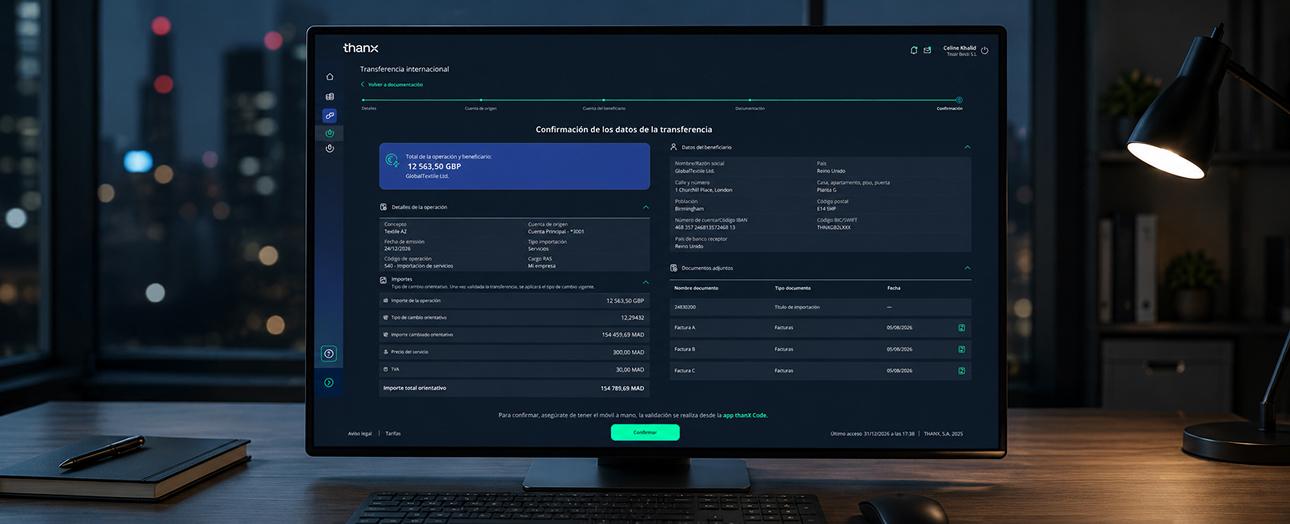
Moroccan companies that import or export products and services need reliable tools to manage their international payments. Whether sending money to a foreign supplier or receiving an international transfer from a client, it is essential to know the available options, legal requirements, and best practices to optimise time and costs.
A good example is thanX, a digital solution that allows companies to send money or make an international transfer with full traceability, real-time visibility, and no paperwork.All from a digital platform, with human support and guaranteed regulatory compliance.
Next, we explain what you should keep in mind when making international transfers from Morocco in line with current regulations.
What options are available for sending money abroad from Morocco?
Traditional banks
Entities such as Attijariwafa Bank, Bank of Africa and BMCI are connected to the SWIFT network and reliably manage international transfers. The usual time frame is 2 to 5 business days, with fees that include a percentage of the amount plus a fixed SWIFT fee.
Fintech services and specialised operators
International business transfers from Morocco can only be managed through banks and operators authorised by the Office des Changes.
Most foreign fintechs, such as Key Currency or TransferMate, do not operate directly in Morocco due to regulatory restrictions.
Before using any platform, it is essential to verify that it is authorised by the Moroccan authorities.
Remittance and urgent payment services
Western Union or MoneyGram allow transfers to be made in minutes, useful for small amounts or emergencies. However, their fees are higher and not intended for recurring business payments.
What documents do you need in order to carry out an international transfer?
To import or export with international payment, certain documentation must be submitted to the bank:
- Single declaration of goods.
- Commercial invoice with exact details.
- Packing list.
- Certificate of origin (when applicable).
- Specific licences or permits if the product requires them.
- Bank receipt or stamped import declaration.
Data consistency between documents is key to avoiding delays or blocks.
Are there any Moroccan regulations regarding sending money abroad?
Morocco allows international trade operations to be carried out without prior authorisation, provided they are well justified. However, any payment must be justified with documentation and recorded in the bank's foreign exchange accounting.
Can I pay a foreign supplier in advance?
Yes, but within limits: up to 30% of the import value or up to 50% in strategic sectors. The remainder is paid upon receipt of the goods or through guarantees such as documentary credits.
What is the exchange rate for the transaction?
Payments are made according to the official rate set by Bank Al-Maghrib within a controlled band. Some companies opt for currency hedges to fix the value in advance and avoid fluctuations.
How can you reduce time and costs in an international transfer?
Applying good practices can make a big difference in your daily operations:
- Negotiate fees with your bank if you make frequent payments.
- Use foreign currency accounts to avoid double conversion fees.
- Group payments to reduce fixed fees for each transaction.
- Plan the dates, avoid weekends or holidays.
- Clearly agree on the expense method (OUR/SHA/BEN) with the supplier.
- Track your transfers with SWIFT GPI to have real-time control.
- Prepare all the documentation in advance to avoid blocks.
What is the import tariff in Morocco?
The tariff depends on the type of product and the country of origin. Morocco has free trade agreements with the European Union, the United States and other countries, which allows for exemptions or reductions. To benefit, make sure you present a valid certificate of origin.
What is the minimum amount to avoid paying customs duties?
There is no general exemption threshold for businesses, but all imports must be declared, including low-value ones.
Enhance your experience with a specialised platform like thanX
thanX is a digital solution created for Moroccan companies that need agility and total control in their international payments. Benefits include:
- Real-time quote before each transaction.
- 100% traceable transfers.
- Digital onboarding without the need for travel.
- Interface in French and support in Dariya.
- Specialised and friendly human support.
The ideal way to modernise your operations and adapt to the new international economy.
How to send money abroad from Morocco: Practical guide for companies
Learn about the available options, local regulations, and best practices for sending money abroad safely and efficiently.
Dirham to euro exchange rate: Keys to protecting your business
If you operate in Morocco and need to convert dirhams to euros, we explain how the exchange rate works, which factors affect it, and how to avoid unnecessary losses.
Keys to making international transfers from Morocco
Discover how to make international transfers from Morocco securely and efficiently. Learn about the requirements, costs, time frames, and how to simplify the process.
How to make payments to international suppliers from Morocco
Discover how to make payments to international suppliers from Morocco. Learn about the available methods, the applicable regulations, and how to manage your operations securely and efficiently.
Your money,without borders
Join thanX