Traditional banking or digital platforms: how to select the best option for your company's international payments
What's better for your company: traditional banking or digital platforms? In this guide, we help you compare both options and choose the one that best suits your international payments.
If your company makes or receives international payments, you have probably wondered about the best way to manage them. For years, traditional banking has been the most widely used option, offering trust and stability. However, in recent years, new digital platforms have emerged, promising greater agility, lower fees, and full transaction traceability.
Choosing between the two is not always easy. Each model has its advantages and limitations, and the key lies in understanding what your business needs. In this article, we explain how they work, what sets them apart, and when it is convenient to combine both to get the best of each.
How does traditional banking work in international payments?
Traditional banking continues to serve as a benchmark for many companies that value security and a direct relationship with their bank. International payments through banks are usually made using SWIFT transfers, a global system that guarantees the traceability and security of transactions.
Its main advantages include:
- Security and institutional support. Banks are supervised by Bank Al-Maghrib and the Exchange Office, ensuring that operations comply with Moroccan and international regulations.
- Personalised service. Having a specialised manager or advisor helps to resolve complex incidents or queries.
- Trust and reputation. For large transactions or with new business partners, traditional banking offers a framework of reliability.
However, the processes can be slower and the costs higher. Often it is necessary to physically go to the branch, present paper documentation, or wait several days for the payment to be processed.
What do digital platforms offer?
Digital platforms, also known as fintechs, are transforming the way international payments are made. These are solutions that allow you to send and receive money online, with fully automated processes and exchange rates updated in real time.
Its main advantages are:
- Speed. Transactions are executed almost instantly, which reduces waiting times.
- Lower costs. Fewer intermediaries and more competitive fees.
- Full traceability. You can track your transfers step by step from your online dashboard.
- 24/7 access. Manage your payments from any device and location.
However, it is important to verify that the platform is authorised and regulated to operate with international currencies. There may also be limitations in personalised support or in the management of high-volume operations.
Comparison between traditional banking and digital platforms
To make an informed choice, it is advisable to compare the most relevant aspects of both models:
- Costs: Traditional banking typically has higher fees and more intermediary processes, while digital platforms tend to offer more competitive exchange rates and lower fees.
- Speed: Banks may require more validations and longer processing times, while digital platforms allow for almost immediate payments.
- Accessibility: Traditional banking often relies on in-person procedures or physical documentation, compared to the online access and 24/7 availability of digital solutions.
- Traceability: Banks offer tracking through their internal systems, while digital platforms show the payment status in real time.
- Security: Both models offer high standards, provided that the entities are regulated and comply with current regulations.
- Media: Traditional banking relies on personalised service; digital platforms on online or chat-based assistance.
In summary, traditional banking stands out for its stability and backing, and digital platforms for their speed, flexibility, and transparency. The choice will depend on the volume of your operations, the level of control you need, and the profile of your business partners.
When is it advisable to combine both options?
More and more companies are opting for a hybrid approach: using traditional banking for strategic or high-value transactions and digital platforms for recurring, lower-value, or urgent payments.
This combination allows you to:
- Maintain the security and support of the banking system.
- Reduce time and fees with digital solutions.
- Adapt flexibly to each type of transaction.
Both traditional banking and digital platforms offer valuable advantages for companies operating internationally. The difference lies in how you use them. Evaluate your company's needs, the type of operations you perform, and the level of control you seek. This way you can choose the best option or combine both to optimise your international payments.
Technology and banking are no longer separate paths: Together, they can help you take your business further.
thanX: the solution that combines the best of both worlds
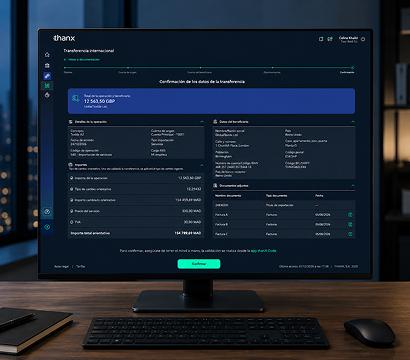
If you're looking for a way to manage your international payments with the speed of a digital platform, but without sacrificing the security and trust of traditional banking, thanX is the answer. Developed by CaixaBank, this tool allows you to:
- Make and receive international payments from Morocco in more than 15 currencies (MAD, EUR, USD, GBP…).
- Operate 100% online, without needing to go to the branch.
- Check the status in real time while the transfer is in process within the platform. Please note that once the transfer is sent and enters the international banking network, thanX cannot report when it will be credited to the destination bank, as that step depends on the intermediary banks and the receiving bank. If there is a problem and the transfer is rejected, thanX will notify you so you can act quickly.
- Receive automatic notifications when there are changes in status or if any problem arises before the transfer is sent.
- Centralise all your transactions on a single platform.
With thanX, your company can enjoy the speed of the digital environment, backed by the strength and reliability of a banking institution.
How to send money abroad from Morocco: Practical guide for companies
Learn about the available options, local regulations, and best practices for sending money abroad safely and efficiently.
Dirham to euro exchange rate: Keys to protecting your business
If you operate in Morocco and need to convert dirhams to euros, we explain how the exchange rate works, which factors affect it, and how to avoid unnecessary losses.
Keys to making international transfers from Morocco
Discover how to make international transfers from Morocco securely and efficiently. Learn about the requirements, costs, time frames, and how to simplify the process.
How to make payments to international suppliers from Morocco
Discover how to make payments to international suppliers from Morocco. Learn about the available methods, the applicable regulations, and how to manage your operations securely and efficiently.
Your money,without borders
Join thanX